
The FY26 NDAA, National Defense Authorization Act, is not a routine defense bill. It feels more like a warning light. Congress is shaping a final package expected to land between $910 and $920 billion, and that range says a lot about where the country thinks the world is headed. The pace of competition has changed. The United States is trying to keep up.
The House version tracks closely with the administration’s $892.6 billion request. The Senate goes bigger at $924.7 billion, driven by concerns over China, the industrial base, and the need to field new technology faster. Staff close to the process describe the bill as “a full-spectrum modernization push” for an era where deterrence cannot be taken for granted. A conference deal is expected in early December, with floor votes to follow before recess.
What stands out is the urgency. The NDAA accelerates AI across the force, pours new money into quantum systems that many national security leaders see as central to future conflict, and leans heavily on commercial technology to cut through years of bureaucratic drag. It tightens export controls, hardens Indo-Pacific posture, and funds a 3.8 percent pay raise. All of it reflects the same concern that readiness has to move faster than risk.
This bill marks a pivot. It shows how Congress sees the next decade of defense, which capabilities matter most, and how quickly the United States believes it must move to protect its edge.
Table of Contents
The Numbers That Matter
To understand the FY26 NDAA, you start with the numbers. They reveal intent more clearly than any press release.
The House authorizes $892.6 billion. The Senate pushes to $924.7 billion. Senior staff call that increase “a necessary correction after years of falling behind our pacing threat.” A final figure between $910 and $920 billion is likely a political compromise that still signals the end of “do more with less.”

The biggest shift sits in RDT&E. The Senate bill drives RDT&E to about $179 billion, a 27 percent jump over the prior year and the largest increase since the Reagan buildup. As one analyst put it,
“Ultimately, the next generation of warfare will not be defined solely by who possesses the most advanced technology, but by who can integrate, adapt, and counter it the fastest.” – Emily Harding
That line covers a lot: AI, quantum, uncrewed systems, long-range fires, hardened networks, and digital engineering.
Procurement rises as well. The Senate version boosts buying power by roughly twenty percent across major accounts, including more than $90 billion for Air Force platforms and munitions. The House spends less but leans harder into reform, pushing the Pentagon to buy off-the-shelf systems and shorten acquisition cycles. “If industry has already built the solution, DoD shouldn’t take five years to buy it,” one member said.
On top of that, the NDAA:
- Funds a 3.8% military pay raise
- Sets aside over $1 billion for Indo-Pacific construction and Taiwan support
- Keeps support for Israel while punting new Ukraine funding to a separate fight
- Tightens oversight on China-linked supply chains, export controls, and cyber vulnerabilities
Money is not a strategy, but it tells you where strategy is pointed. Here, it points toward speed, resilience, and a bet that technology will be the deciding factor.
The Shift to Tech Dominance
If the FY26 NDAA has a core theme, it is this, technology now drives strategy.
China sits at the center of that shift. Not as a far-off risk, but as a competitor reshaping timelines. A senior Pentagon official told Congress that “the future fight will hinge on who adapts technology into operations first, not who invents it.” That mindset shaped both the Senate’s higher topline and the House’s reform agenda.
AI moves from experiment to expectation. Both chambers call for broader use of AI in logistics, maintenance, cyber defense, and targeting. “Every month we wait is a month our adversaries use to train models we haven’t even deployed,” one member warned.
Autonomy follows the same logic. Uncrewed systems—air, maritime, and ground—are funded across multiple accounts, alongside digital engineering standards meant to shorten the path from prototype to fielded capability.
On the quantum front, the bill creates a dedicated DoD office, expands test corridors, and funds early prototypes. Experts told Congress that quantum systems could “rewrite the rules of deterrence” if one side gains a meaningful lead. Lawmakers responded by treating quantum as a strategic race rather than a science project.
Underneath it all sits a cultural change, the Pentagon is being told to adopt commercial technology at scale.
“If Silicon Valley can deliver a breakthrough in 12 months, the DoD can’t spend the next 60 reinventing the wheel through endless red tape.” – Rep. Rob Wittman (R-VA)
The broader signal: technological superiority is no longer assumed. It has to be rebuilt, and quickly.

Commercial Tech Becomes the New Arsenal
The NDAA takes commercial tech from “nice to have” to core arsenal.
The commercial sector outspends the Pentagon on R&D by a wide margin and builds AI, autonomy, and software at a speed the government cannot match. As one DIU leader put it, “We don’t have an innovation problem. We have an adoption problem.”
Section 804 reforms require the services to use streamlined pathways for off-the-shelf technology, cutting timelines from years to months. About $500 million is set aside for pilots that test commercial tools in real missions. Congress wants working systems, not slide decks.
The Defense Innovation Unit gets an extra $200 million to work with over two hundred firms, many of them early-stage. Lawmakers even set a target by 2028, roughly 20% of procurement contracts should prioritize commercial items.
This reflects a broader belief that the defense industrial base is now hybrid. Primes, software companies, autonomy startups, sensor makers, and advanced materials firms are all part of the same ecosystem.
The NDAA also challenges old gatekeeping models. A senator captured the frustration: “America cannot afford systems that take ten years to field and fifteen years to upgrade.” For dual-use startups, that frustration is an opportunity.
At the strategy level, this pivot is about proving speed and resilience by getting capabilities into the field while the clock is still running.
Troop-Led Repairs: The Quiet Revolution in Readiness
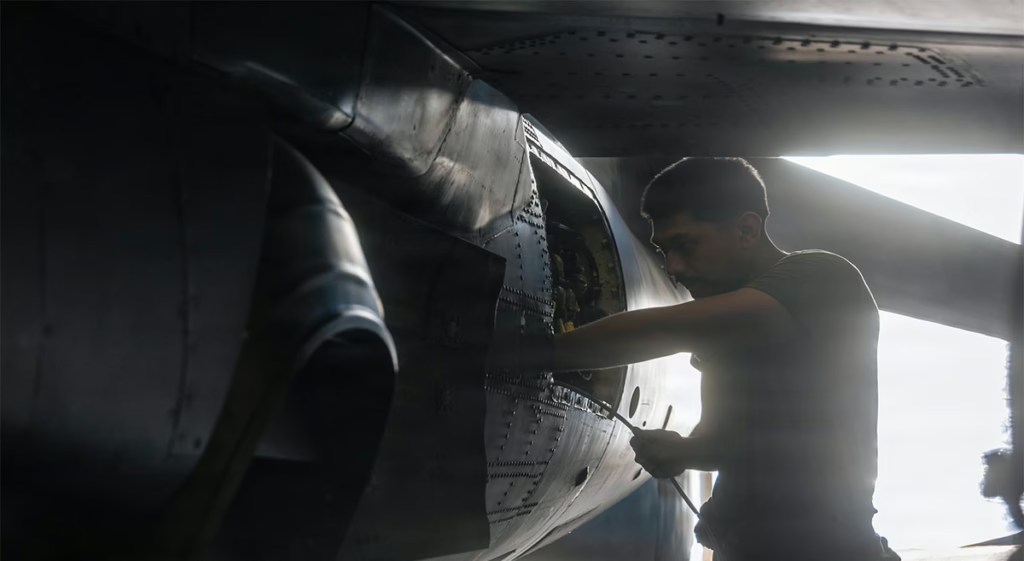
One of the quiet revolutions in the FY26 NDAA is troop-led repair.
For years, the sustainment model leaned heavily on contractors. They owned the data, the diagnostics, and often the tools. That meant long delays, high costs, and units that sometimes needed permission to fix their own gear.
The Senate’s ICOR provision, Instructions for Continued Operational Readiness, changes that. It requires contractors to provide the data, manuals, and software keys needed to maintain equipment. One senator called it “the most important readiness change in a generation.” The House mirrors this through Section 328, including for marquee systems like the F-35.
The bill backs this up with funding of over $1 billion for Army and Navy depots to train around 50,000 personnel in modular maintenance, 3D printing, and advanced repair techniques, plus $150 million for pilot programs at 10 bases. A Marine logistician summed up the problem: “We’ve built a generation of warfighters who can operate the most advanced systems in the world but can’t repair a cracked housing without a contractor ticket.”
If you’re going to have a trillion-dollar military budget, you should be able to fix what you bought and paid for. – Louis Rossmann
The impact is straightforward. Troop-led repairs cut downtime, reduce sustainment costs, and create a force that can keep its own equipment running in contested environments.
For the industry, it signals the end of sustainment models built on tight control over basic repair information. Guardrails on IP will matter, but the direction is clear the military will not accept maintenance bottlenecks as a fact of life.
In high-tempo conflict, the force that can fix its own gear wins time. This NDAA treats that as a core capability, not a side issue.
Quantum, Export Controls, and the China Through-Line
The quantum push, tighter export controls, and China language all fit together.
On quantum, the NDAA creates a DoW office to coordinate efforts, funds about $300 million for prototypes, testbeds, and demonstrations, and aims to build a 10,000-person quantum workforce. It bans Chinese quantum technology from defense supply chains and requires verification of the origins of key components. A senior advisor warned that “quantum sensing could erode traditional advantages in air and maritime stealth within a decade.” Congress took that timeline seriously.
On export controls, the GAIN AI Act requires major chip makers to prioritize U.S. buyers for advanced GPUs and gives Commerce more resources to pursue shell companies and third-country routing. The Remote Access Security Act adds a new lens: if a system can be exploited remotely through telemetry or update channels, the sale can be stopped.
At the same time, the NDAA eases cooperation with allies, expanding fast-track approvals for Five Eyes and AUKUS partners, especially in chips, quantum, and AI tools. The idea is to build a shared technology base with trusted nations while tightening the screws on adversaries.
Underneath all of this is China. From Indo-Pacific basing and Taiwan support to munitions production and industrial surge capacity, the bill is shaped by a long competition with Beijing. Hardening bases, increasing magazines, and stabilizing supply chains are all pieces of the same story.
The through-line is simple: technology, chips, and industrial capacity are now strategic terrain, and the United States intends to shape it.

What This Means for Defense Contractors
For contractors, the FY26 NDAA is not background noise. It is the operating environment.
The most immediate shift is tempo. “The Pentagon cannot outwait its adversaries anymore,” a senior HASC member said. Programs that cannot move fast will struggle. Firms with modular designs, digital twins, and agile integration will outpace those built around slow, monolithic development.
The rise of commercial-first pathways means nontraditional vendors, software-first firms, and dual-use startups have real ways into DoW programs. Incumbents can still win, but only if they start to look and move more like commercial companies and prove performance earlier.
Supply chain integrity moves from compliance checkbox to competitive factor. Export controls and China-focused bans mean contractors will have to prove where components come from, how software is controlled, and how vendors are vetted. “If you don’t know where your components come from, you won’t be selling them to the Pentagon,” a Commerce official warned.
Sustainment models will have to adapt. Right-to-repair reforms change the leverage on long-term service deals. Revenue will shift toward upgrades, integration, predictive tools, and rapid replacement, rather than locking up basic maintenance.
To thrive in this environment, contractors should focus on:
- Accelerating development cycles with modular design and digital engineering.
- Building clean, documented supply chains with less foreign exposure.
- Showing commercial readiness, not just technical potential.
- Designing for interoperability, especially in Indo-Pacific scenarios.
- Investing in integration and sustainment approaches that reduce friction and time to field.
This NDAA rewards companies that build, adapt, and deliver at speed. It pressures those that depend on long timelines and fragile models.
Closing Analysis
The FY26 NDAA is more than a list of authorizations. It is a statement about how the United States intends to compete.
What comes next is execution. Authorization is only the first step. Appropriations decide what gets funded. Implementation decides what becomes a real capability. “The gap between authorization and operational capability is where we win or lose time,” a senior defense official told Congress.
Appropriators, the services, and industry will all decide whether this momentum sticks. Some programs will accelerate. Others will stall. The difference will come down to how seriously each actor takes the message baked into this bill: modernization is not optional and not distant.
China is moving fast. Russia remains disruptive. Emerging threats evolve faster than traditional procurement cycles. Congress knows this. The services know it. Industry is beginning to act as if it knows it too.
This feels like an inflection point. Not just because the topline is higher, but because Washington is finally admitting the timeline it is on. Competition is not “over the horizon.” It’s here.
The FY26 NDAA is a blueprint for moving faster. The next year will show whether the nation actually follows it.
