
This conflict now drives real-time shifts in Pentagon readiness definitions, funding, and capability evaluation. Its impact is already visible in asset losses, munitions decisions, and budget trade-offs.
This past week underscored how the Middle East conflict, once seen as limited, is now changing how the Pentagon spends money, reviews technology, and measures readiness.
The strike on Prince Sultan Air Base damaged essential assets used during daily operations. Concurrent troop movements, munitions choices, and new platform updates all highlight urgent operational risks requiring immediate adjustments to resource deployment and force posture. These developments are forcing changes in air defense positioning, asset dispersion, and resupply priorities to close operational gaps.
Together, these examples illustrate a noticeable pivot, a shift from traditional planning to direct, real-time resource management, signaling a broader operational transition within the Department of Defense.
What Actually Happened
The March 27 strike damaged a valuable E-3 AWACS and several refueling planes. The E-3 provides airborne command and control, so its loss immediately reduces awareness and coordination.
At the same time, 82nd Airborne and Marine elements kept arriving. This shows flexibility, the ability to increase forces, not automatic escalation.
The munitions issue continues. Reports say air defense interceptors for Ukraine may move elsewhere. This is about logistics, not politics. These shortfalls show limits in surge capacity and inventory visibility. Production uses existing contracts. Inventory management is shifting to real-time tracking and faster distribution. Forward supply and rapid delivery are now operational requirements, not planning assumptions.
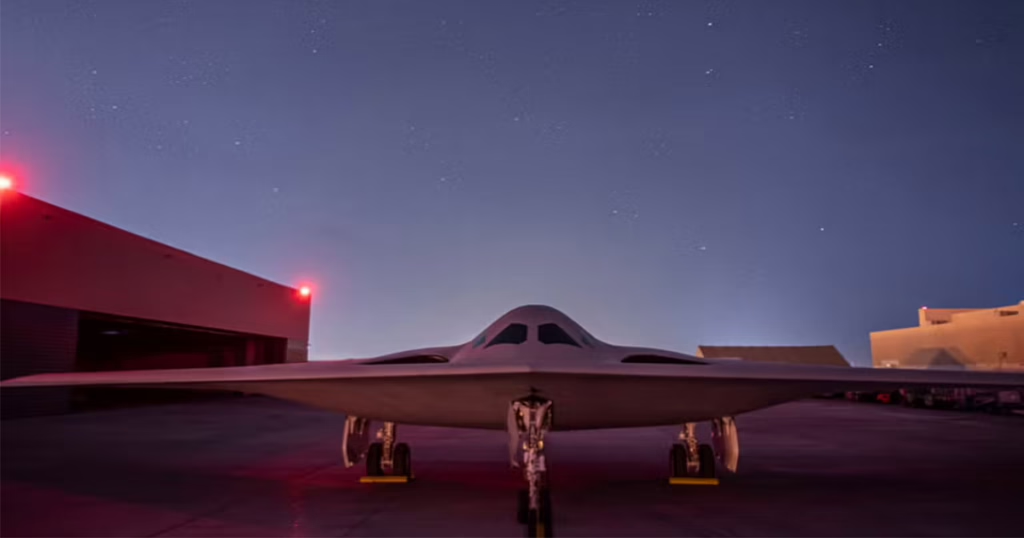
New B-21 sensor fusion and onboard computing reports point to greater use of digital tools in operations. The system aims to meet present needs while planning for the future.
Operational Reality Is Driving Requirements Now

The strike proved what has been talked about for years: fixed bases and valuable aircraft are at risk in a world where cheap, mass attacks are common.
The cost issue is clear. Using expensive interceptors against cheap drones and missiles is unsustainable. It burns through supplies and forces hard choices.
That is already pushing demand in a few directions:
- Layered counter-UAS systems that can operate at a lower cost per engagement
- Directed energy solutions that reduce reliance on kinetic interceptors
- Autonomous defensive systems that can scale without increasing manpower
- More resilient command-and-control architectures that do not rely on a single platform
Sustainment is a challenge. Fast-paced operations expose problems with repairs, spare parts, and resupply. Peacetime contracts are now being tested in real scenarios. These gaps are forcing changes in contracts, forward repairs, and parts delivery. The focus is on maintaining tempo under sustained demand, not peacetime efficiency.
This is not a survivability problem in isolation. It is a scaling problem across every layer of defense.
FY26 Is Already Being Reshaped
Budget talks are rapid. Munitions and air defense budgets are under pressure, and moving interceptors between regions indicates a rapid shift.
This is not about favoring one region. It is about keeping operations running without waiting for the next budget cycle.
Early signs show a greater focus on missile defense, long-range precision weapons, and expanding the industrial base for surges. The point is that these priorities address current needs, not just future plans.
“Wartime footing” is becoming a reality. Contracts are now based on usage, not just plans.
Programs that cannot show how they will be built will face more scrutiny. The most at risk are those with long development cycles, such as new crewed aircraft not in production, high-cost missile defense programs with delays, and IT modernization without deployment plans. Initiatives that require new supply chains or immature manufacturing may face delays and reviews. The focus is on what can be built, scaled, and fielded fast.
The limit is no longer innovation. Production capacity, supply chain resilience, and the sustainment of multi-theater operations are now the focus.
The Indo-Pacific Is Still in the Background
None of this is happening alone. China and others are paying close attention.
The U.S. Army notes that while drone saturation and forward base strikes matter, the U.S. has not run a large maritime campaign since World War II, a special challenge for Pacific plans. The question is whether the U.S. can keep credible deterrence in both regions.
The constraint is now the industrial base: can it sustain simultaneous demand without degrading support in either theater?
This is where tension is clear.
The B-21 is built for future wars, especially in the Indo-Pacific. But today’s fighting depletes munitions, support, and resources those missions will need.
Scalability and seamless integration are now non-negotiable for systems that have to function across multiple regions.
Technology Is Moving Faster Under Pressure
Conflict accelerates adoption, and it’s already visible.
The B-21 shows why advanced tech investment matters, even as short-term needs grow. Other technologies are progressing faster:
- Autonomous systems for defense and surveillance
- Additive manufacturing for forward sustainment
- AI-enabled tools for counter-drone operations
Earlier framework agreements are now being tested. Delivery and steady production matter more. The time from prototype to use is shrinking.
This is a window for technology ready for fast use, not just early ideas.
Where This Is Heading
The next phase will continue to pressure munitions supplies and accelerate funding changes. Expect extra funding requests and a focus on logistics and counter-UAS systems.
This change is significant and lasting.
A recent report says the Pentagon may send 10,000 more troops to the Middle East. This suggests a shift toward viewing regions as connected in terms of resources, technology, and planning.
Adapt now or risk falling behind as operations speed up.
The system is adjusting. The only variable is how fast organizations keep up.
